Your sales team won’t use your leads. Not because they don’t trust you. But because most of them are garbage.
That’s not hyperbole. The average B2B company wastes 65% of the leads marketing generates. Sales team never touches them. Why? Because most aren’t qualified.
A lead scoring system fixes this. Not a theoretical one. A practical one. Built on your actual data. That predicts which leads your sales team will convert.
I’ve built and rebuilt scoring systems for dozens of companies. And here’s what I’ve learned: the best ones are simple. Not complex. And they’re based on what you actually know about your customers, not what you think should matter.
How Most Companies Get Scoring Wrong
Typical scoring system: A lead fills out a form? 10 points. They visit the pricing page? 5 points. They open an email? 2 points. Reach 50 points and they’re a Marketing Qualified Lead (MQL).
The problem: your sales team gets a list of people who filled out a form and read an email. Not people who are actually qualified.
The result: reps don’t follow up. Or they do and it’s a tire-kicker. Lead quality falls. Sales blames marketing. Marketing blames lead volume. Both sides are frustrated.
Here’s what I see in smarter companies: they build scoring on two dimensions. Explicit and implicit.
Dimension 1: Explicit (Demographic) Scoring
Explicit data is what you ask the prospect. Company size. Industry. Role. Budget range.
Some companies fall in your sweet spot for revenue. Others don’t. Some industries buy your product. Others have no use for it.
Your data scientist or marketing ops person should build a simple model. Analyze your won deals. What companies bought? What size were they? What industries?
Then create a scoring rule: if company is between 500-5,000 people, add 20 points. If industry is SaaS, add 15 points. If role is VP Sales or Sales Director, add 25 points. If they indicated budget of $50K+, add 30 points.
Suddenly a prospect who’s the right company size, in the right industry, in the right role, with the right budget gets 90 points. That’s an MQL.
A prospect who’s a small company outside your ICP, in a different industry, different role? Maybe 10 points. Send them to nurture. Don’t bother your sales team.
Dimension 2: Implicit (Behavioral) Scoring
Implicit data is what they do. How engaged are they?
Build a scoring system around actual behavior:
Content download (1 point). Email open (1 point). Email click (2 points). Website visit (1 point per visit, max 10 points per week). Demo request (50 points). Pricing page visit (15 points). Competitive comparison page (25 points). Case study view (10 points).
Here’s the key: weight these by what actually matters. A demo request is worth 50 times more than an email open.
Why? Because you have historical data. Look at which behaviors correlate with conversion. Demo requests from qualified companies convert at 30%+. Email opens from unqualified companies convert at less than 1%.
Weight your scoring to match reality.
The Decay Factor
Here’s what most scoring systems miss: recency.
A prospect visited your website two years ago. They filled out a form once. They’re sitting at 45 points. Is that a qualified lead?
No. They’re cold.
Build in a decay factor. Points from six months ago? Worth half as much. Points from a year ago? Basically worthless. Points from this week? Full value.
This keeps your scoring focused on active interest. Not some ghost prospect who filled out a form two years ago.
Setting Your MQL Threshold
Here’s where it gets tricky.
What score makes someone an MQL? It depends on your business.
If you’re B2B SaaS with self-serve, maybe it’s 40 points. If you’re enterprise software with long sales cycles, maybe it’s 70 points.
Here’s how to find it: look at your historical data. Take 100 leads that converted to customers. Calculate their score the day they converted. What was the median score?
Let’s say the median was 65 points. That’s your threshold.
Now test it. Use 65 as your MQL threshold for the next quarter. Track what percentage of MQLs your sales team converts. Track velocity (how long from MQL to customer).
Then adjust. If your conversion rate is 40%, raise the threshold. If it’s 5%, lower it.
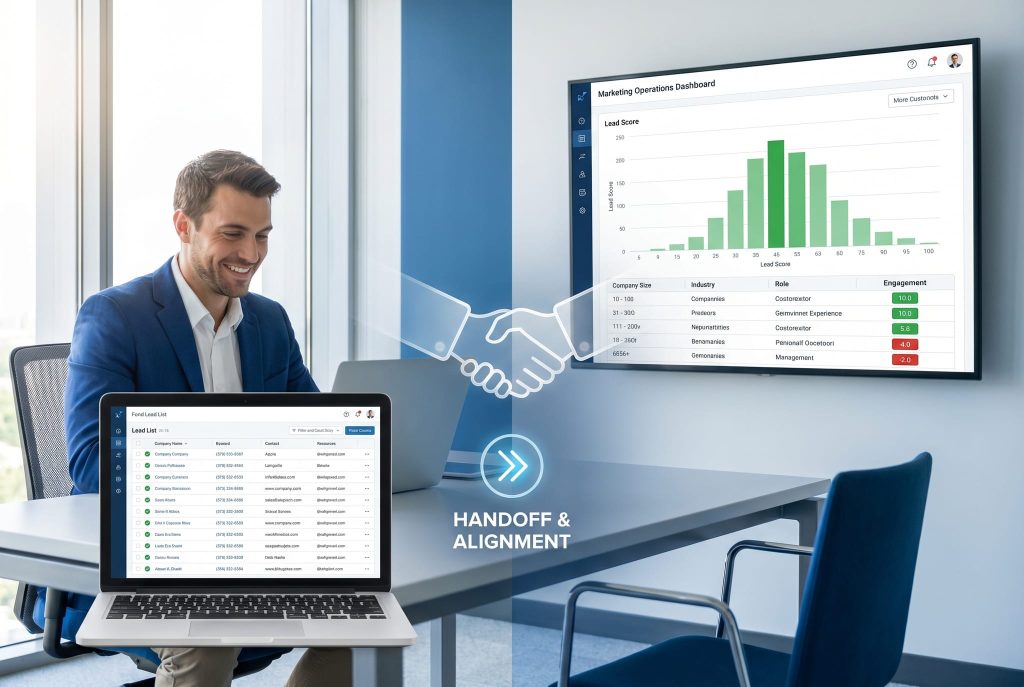
The Sales-Marketing Handoff
This is where most systems fall apart.
Marketing says someone is an MQL. Sales says they’re not qualified. They fight about it.
The solution: agree on what an MQL is. Write it down. Make it clear.
“An MQL is a prospect who meets our ideal customer profile (company size, industry, budget range) AND has demonstrated active engagement (visited website 3+ times, opened 2+ emails, or requested a demo).”
Clear. Measurable. Both sides understand it.
Then track how many MQLs convert to SQL (Sales Qualified Lead). Track conversion rate. If marketing is sending garbage, the conversion rate will be terrible. If sales isn’t following up, you’ll have leads sitting without activity.
Multi-Touch Attribution
Here’s a bonus: most scoring systems only look at individual prospect behavior.
But B2B deals involve multiple people. Your champion champion has been looking at your content for weeks. But your economic buyer just got involved. Their behavior doesn’t show your entire opportunity.
Account-based scoring looks at all the activity across an account. Marketing person visited pricing. Finance person downloaded your ROI calculator. Two salespeople looked at case studies. Three engineers downloaded your technical specs.
This tells you: account is active. Multiple stakeholders are engaged. Sales should prioritize it.
This is harder to build but worth it if you’re in enterprise.
Common Mistakes to Avoid
Don’t score on email list size. A big email doesn’t mean high quality.
Don’t make scoring too complicated. If your system has 47 rules and five decay factors, your team won’t maintain it.
Don’t forget to update your model. Markets change. Your customers change. Rescore quarterly.
Don’t let scoring replace human judgment. If a rep has a relationship with a prospect, their judgment matters. Scoring is a guide, not a rule.
Measuring Success
Once your system is live, measure:
MQL volume: Are we generating enough qualified leads?
MQL quality: What percentage convert to SQL? To customer?
MQL velocity: How fast do they move through the funnel?
Sales efficiency: What’s our cost per closed deal? Is it improving?
Track these metrics monthly. Adjust your scoring if they’re off.
The Payoff
Good lead scoring cuts your sales cycle by 20-30%. Your team focuses on qualified leads. Close rates go up. And suddenly sales doesn’t hate marketing for flooding them with junk.
I’ve seen it move close rates from 8% to 12%. That might not sound big. But on 100 MQLs, that’s four more deals. Four more deals is revenue.
Start simple. Build on what you know. Test and iterate.